
In real estate, control is everything. It’s your project, your vision, your risk—so why should someone else be calling the shots? For many new and growing investors, the idea of bringing in an equity partner raises a red flag: Will I lose control of my deal?
The good news? You don’t have to. With the right strategy, equity partnerships can give you access to the capital you need—while you stay in the driver’s seat.
In this blog, we’ll break down how to structure partnerships that preserve your leadership, fund bigger projects, and align incentives for long-term success.
Why Investors Turn to Equity Partners
Let’s face it: real estate is capital-intensive. Whether you’re doing your first flip or developing a 10-unit build, the numbers rarely work without a strong capital stack. When loans or bridge financing fall short, many investors turn to equity partners to fill the gap.
Equity partners typically provide funds in exchange for a share of profits. But unlike lenders, they don’t receive fixed interest—they’re invested in the success (and risk) of the project.
You might need an equity partner if:
- You’ve found a deal that’s too big for your current capital
- You’re short on cash for renovations or closing
- You’re scaling and need liquidity to take on multiple projects
- You want to build a track record using other people’s money
But here’s the catch: when you take equity, you risk losing control—unless the deal is structured properly.
How to Structure Equity Partnerships Strategically
There’s no one-size-fits-all deal structure—but the best partnerships share one trait: clarity.
Start with an LLC or joint venture (JV) agreement that outlines exactly:
- Who does what
- Who puts in what
- How profits are split
- When decisions need joint approval
- What happens if someone wants out
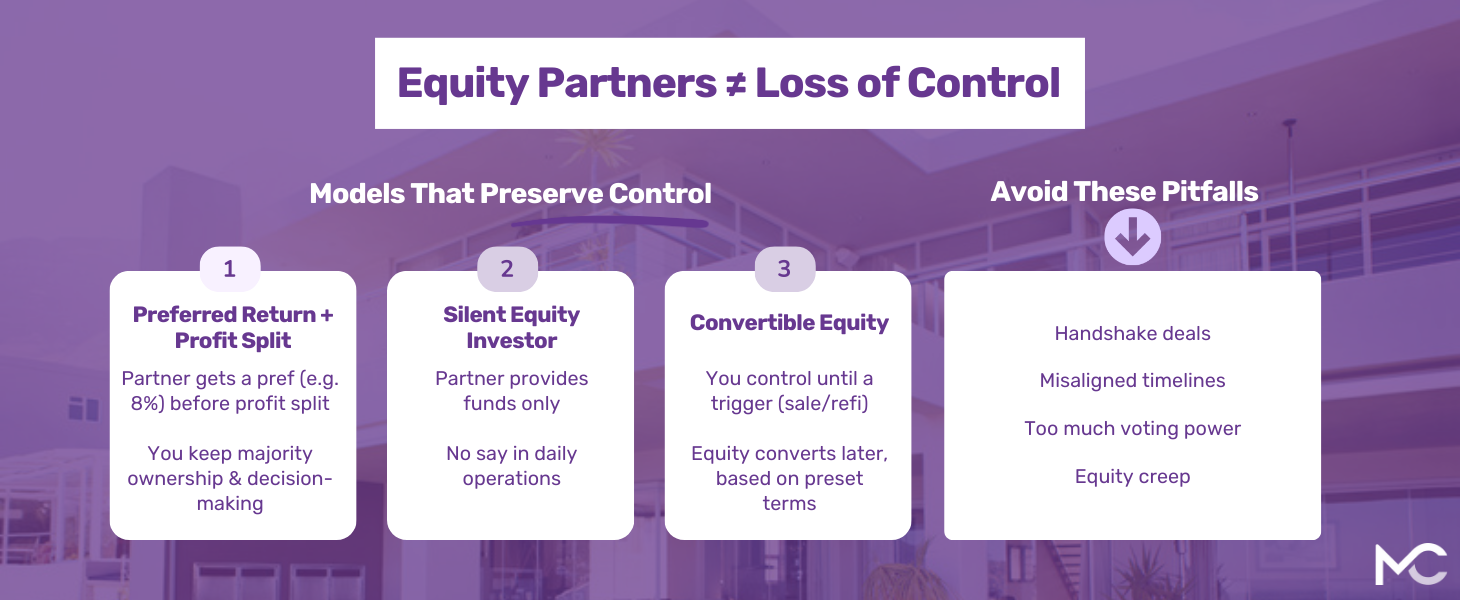
3 Models That Preserve Control for You (the Operator):
- Preferred Return + Profit Split: The partner receives a set “pref” (say 8%) on their capital before you split profits. You maintain majority ownership and decision-making power.
- Silent Equity Investor: They fund the deal but are not involved in day-to-day decisions. Their role is strictly financial, not operational.
- Convertible Equity: You retain full control until a specific milestone (e.g., sale or refi). At that point, the equity converts based on preset terms.
You can download a sample JV agreement from Nolo
How Much Control Is Too Much?
Control isn’t just about who picks the tile backsplash. It’s about who can sign checks, change the budget, hire contractors, or pivot the exit strategy. Unless you define these powers upfront, even minority partners can create friction.
We’ve seen deals implode because a 25% partner blocked a refinance, or insisted on selling before a project was stabilized. This is where governance terms matter just as much as ownership percentage.
Pro tip: even with 100% of the sweat equity, if you don’t control the bank account, you don’t control the deal.
Real-Life Example: Control Without Conflict
Kara, a repeat investor in Florida, found a duplex listed off-market for $440,000. She estimated a $120,000 rehab and ARV of $750,000. Her lender covered 75% of the purchase and 100% of the rehab—but she still needed $75K in gap funding.
She brought in a passive equity partner on a 70/30 profit split after a 10% preferred return. Kara retained full operational control via an LLC operating agreement and managed every aspect of the flip. Six months later, they sold for $745,000—her partner earned a solid return, and Kara maintained her leadership and brand.
What to Watch Out For
- Unclear terms: “Handshake” deals often end in disaster
- Misaligned timelines: Make sure your partner agrees on the exit
- Decision paralysis: Limit voting rights to key decisions only
- Equity creep: Don’t give up more than necessary—especially if you’re doing all the work
To avoid these, use a strong operating agreement and work with advisors who understand real estate-specific structuring.
Final Thoughts: Partner Without Losing Power
Equity partners can help you unlock bigger deals, take on more projects, and scale your real estate business. But only if you keep the reins and are aligned.
By structuring agreements that protect your role as operator, you can build real wealth—without letting someone else call the shots. Equity doesn’t have to mean compromise.
At Malve Capital, we work with experienced investors and first-time operators to fund deals with flexibility and agility. Whether you need gap funding, private capital, or help structuring your partnership, we’re here to help.