
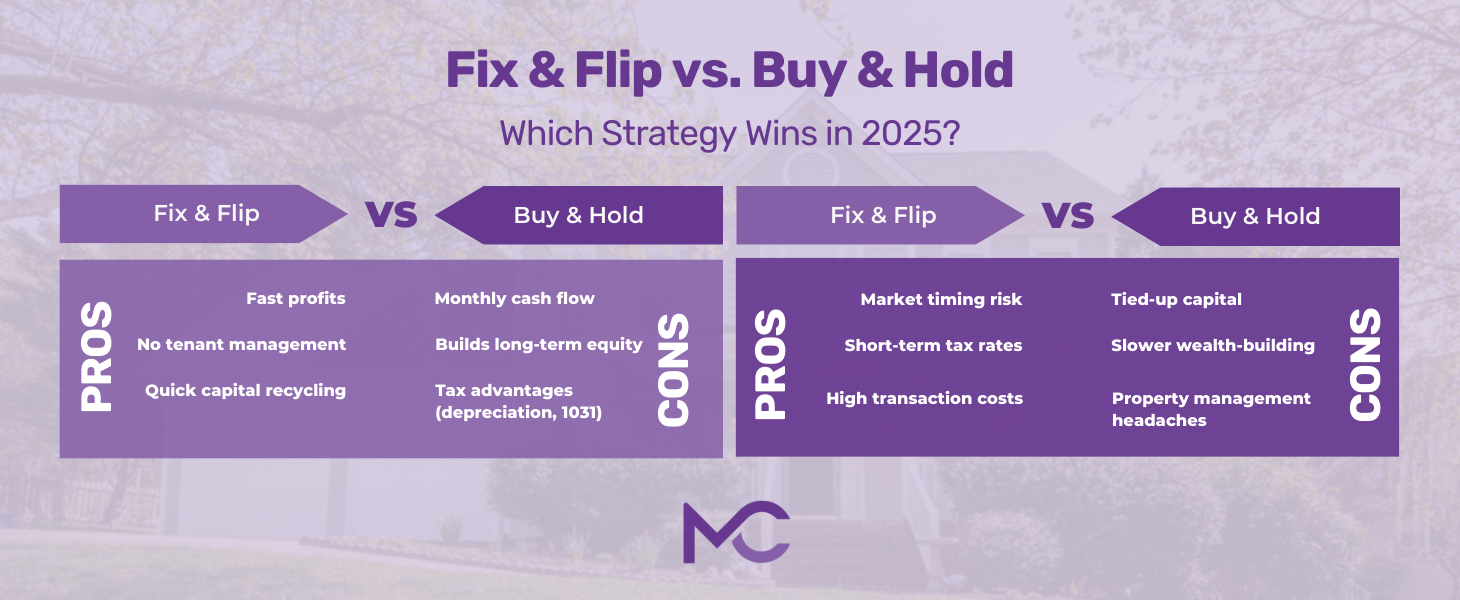
If you’re exploring real estate investing in 2025, you’ve likely asked yourself: “Should I flip this house or rent it out long term?” It’s one of the most critical decisions an investor can make—and it comes down to your goals, risk tolerance, and how quickly you need capital to work for you.
In this guide, we’ll compare the two strategies, explore their pros and cons, and break down how to fund either approach—without relying on traditional banks.
Why the Strategy You Choose Matters
Real estate is full of potential, but not all returns are created equal. Some investors want quick profits. Others want long-term passive income. And some want both.
Fix and flip and buy and hold each serve different purposes. Understanding the differences will help you invest with confidence—and avoid expensive mistakes.
What Is Fix and Flip?
A fix and flip is a short-term investment strategy where you buy a distressed or undervalued property, renovate it, and sell it for a profit—usually within 6 to 18 months.
Fix and Flip Pros:
- Potential for fast profits
- Doesn’t require long-term tenant management
- Allows you to reinvest capital quickly
Fix and Flip Cons:
- Higher transaction costs (closing, renovation, resale)
- Requires strong project management
- Susceptible to market timing risk
- Short-term capital gains taxes
What Is Buy and Hold?
Buy and hold is a long-term strategy where you purchase a property and rent it out over time, collecting monthly income while the property appreciates.
Buy and Hold Pros:
- Generates passive monthly cash flow
- Builds equity through appreciation and mortgage paydown
- Long-term tax advantages (e.g., depreciation, 1031 exchanges)
Buy and Hold Cons:
- Involves property management and maintenance
- Requires tenant screening and ongoing oversight
- Capital is tied up for years
For deeper dives into each strategy, check out Landlordology, and BiggerPockets.
Which Strategy Is Best in 2025?
There’s no universal answer—but here’s a quick breakdown based on current market trends:
Choose Fix and Flip if:
- You want faster returns
- You’re comfortable managing a renovation
- You’re operating in a hot or emerging market
- You’re working with short-term capital
Choose Buy and Hold if:
- You’re building long-term wealth
- You prefer steady income over lump-sum profits
- You’re focused on appreciation and tax strategy
- You want to diversify with multiple rentals over time
Redfin reports that while flipping profits are down slightly due to rising renovation costs, savvy investors who can source deals and fund quickly are still outperforming average returns.
Meanwhile, Census.gov shows growing demand for rental housing in metros like Dallas, Atlanta, and Jacksonville—making buy and hold increasingly attractive for cash flow investors.
How to Fund Either Strategy Without a Bank
Traditional bank loans aren’t built for investors. They’re slow, rigid, and documentation-heavy. That’s a problem when you need to close fast—or fund multiple projects in a year.
Private lending offers a flexible alternative. At Malve Capital, we help investors finance both fix and flip and buy and hold deals with speed and simplicity.
Fix and Flip Loans
- Close in as little as 5 business days
- Loans based on After Repair Value (ARV)
- No income verification or tax returns
- Soft credit checks only
- Interest-only payments, 6–18 month terms
Rental Property Loans (Buy and Hold)
- Long-term DSCR rental loan options (30-year fixed or adjustable)
- Ideal for investors refinancing a flip into a rental
- Faster closings than conventional banks
- No personal income docs required
How Savvy Investors Use Both Strategies
Many experienced investors start with flips to build capital and then transition into buy and hold for long-term wealth.
Others flip during seller markets and buy-and-hold in softer ones. Your strategy doesn’t have to be permanent—it just needs to match your goals today.
For example, a New Jersey investor recently used Malve Capital to fund three flips in 12 months. He reinvested the profits into two rental duplexes—locking in monthly income while preserving upside through appreciation.
What Lenders Care About
Private lenders aren’t focused on your W-2 income or credit score. Instead, they evaluate:
- The deal: purchase price, renovation scope, and comps
- The strategy: flip and sell vs. buy and refinance
- The timeline: short-term project or long-term hold
- Your experience or your team’s track record
Final Thoughts
Fix and flip vs. buy and hold isn’t a debate—it’s a decision about strategy, speed, and capital.
If you want to build cash fast and reinvest quickly, flipping may be your path.
If you want monthly income and wealth over time, buy and hold may serve you better.
Either way, you don’t need a bank to get started. Private lending gives you the capital, flexibility, and speed to compete in today’s market.
Thinking about your next deal? Talk to a Malve Capital advisor and get a term sheet in just a few minutes. We’ll help you close in days—not months.